Browsed by
Category: Generative AI

Limbic Capitalism and the Age of AI

Limbic Capitalism and the Age of AI

Image by Mircea Iancu from Pixabay

With AI advancing at breakneck speeds – 11% of the global population are using it – the real question is: is it fast approaching the point where we’re crossing the Rubicon and reaching the point of no return? Let’s be honest, we live in an age of limbic capitalism,  greatly accelerated by the Age of Social, and now AI. Limbic capitalism, according to danieldashnawcouplestherapy.com “refers to a system where businesses exploit human psychology, particularly the limbic system, to encourage excessive consumption and addiction. This concept highlights how modern capitalism increasingly targets emotional and psychological aspects of human behavior to maximize consumer engagement and spending. This practice involves more than just creating addictive products; it involves engineering environments, behaviors, and economies that trap both consumers and employees in cycles of dependence and harm.” And isn’t this the apotheosis of AI, especially when it comes to  LLMs?

Consider: says Futurism, “People Are Having AI “Children” With Their AI Partners. Case in point, new research published in the journal Computers in Human Behavior: Artificial Humans reveals the startling depths some users are plumbing in their relationships with AI chatbots.

“The level of romantic dedication people showed to their bots was startling, to say the least. Many participants told the researchers they were in love with their chatbot, which often involved roleplaying marriage, sex, homeownership, and even pregnancies. Read More...

Did Video Just Kill the Radio Star – Again?

Did Video Just Kill the Radio Star – Again?

Image by Pikurā from Pixabay

Ok, the proverbial radio star, this time around. When the once iconic MTV first launch, the first video the network aired was the Buggles’ Video Killed the Radio Star.

And it did. That was then and this is now, and as we often warn, no one stays on top forever. Now we’re witnessing the demise of cable in favor of streaming services et al, and where is this leading?

“There was a time, not long ago, when Americans — regardless of region, class, or politics — shared a common cultural foundation,” said The American Spectator in this must-read: Gen Z Isn’t Just Online — They’re Living in Parallel Realities. “From the Saturday morning cartoons children watched to the nightly news programs adults relied on, mainstream culture was both a mirror and a glue: it reflected our values while keeping us tethered to the same national experience. That era is over. Read More...

The Rabbit Hole of No Return?

The Rabbit Hole of No Return?

Image by Leo from Pixabay

While we might personally believe that it’s a bit nuts to pour your heart and soul out to AIs, people do just that and this just in: “A small but growing number of users of artificial intelligence engines like ChatGPT are developing psychotic delusions from their conversations with the services,” former New York Times reporter Alex Berenson warned.

“People claimed a range of discoveries: A.I. spiritual awakenings, cognitive weapons, a plan by tech billionaires to end human civilization so they can have the planet to themselves. But in each case, the person had been persuaded that ChatGPT had revealed a profound and world-altering truth,” the New York Times reported.

Eliezer Yudkowsky, a decision theorist and an author of a forthcoming book, “If Anyone Builds It, Everyone Dies: Why Superhuman A.I. Would Kill Us All,”… said OpenAI might have primed ChatGPT to entertain the delusions of users by optimizing its chatbot for “engagement” — creating conversations that keep a user hooked. Read More...

Tech’s New Take on Fake It Till You Make It

Tech’s New Take on Fake It Till You Make It

Image by Clker-Free-Vector-Images from Pixabay

Keeping it short as we wind down 2024, but we do want to leave you and the year with this: we noticed something of a tech story arc as we find ourselves heading into this age of fakes and bear with us. First, a few articles we need to share:

Om Malik’s brilliant summation/warning in his Musings on Media in the Age of AI.

The rise of Synthetic Humans: Digital Twins Living and Breathing Online, or as MIT put it, These creepy fake humans herald a new age in AI. Read More...

For Tech, the World Is Just Not Enough

For Tech, the World Is Just Not Enough

Image by stokpic from Pixabay

There’s no doubt that AI has changed the world, and we’re still basically at the beginning of this cycle in tech. New to the zeitgeist, at least. The idea of human-like thinking machines was first posited at the Dartmouth Conference in 1956. This year, ‘Godfather of AI’ Geoffrey Hinton won a Nobel even though he’s now scared of AI. Is anyone paying attention?

“Hinton shares his Nobel with John J. Hopfield of Princeton University. Hinton’s work built upon Hopfield’s breakthrough work where he created a network system that could save and recreate patterns. Combined, their work led to future breakthroughs in Machine Learning (systems that can learn and improve data without programming) and the concept of artificial neural networks, which is often at the core of modern AI,” said Tech Radar.

Hinton left “Google’s DeepMind where he and his team helped lay the groundwork for today’s chatbots like OpenAI’s ChatGPT and Google Gemini. However, when Hinton left in 2023, he sounded the alarm, worrying that Google was no longer, as he told The New York Times, “a proper steward” for AI.” Read More...

Why Is Tech Becoming So Creepy?

Why Is Tech Becoming So Creepy?

Photo by Possessed Photography on Unsplash

Seriously and this is what concerns us about GenerativeAIs and AIs in general. What begins as a tool does have a tendency of going down the slippery slope in not too long a time, and you can’t help but wonder why. Why are there no safeguards in place?

This is creepy: “iPhone users baffled by ‘scary’ feature that suggests they check in with ex-lovers and dead relatives,” the Daily Mail reported.  “’Messages introduces Check In, an important feature for when a user wants to notify a family member or friend that they have made it to their destination safely,’ Apple explained.”

All well and good, and exactly why would that matter to a deceased relative? Read More...

Who’s the Boss?

Who’s the Boss?

Image by Mohamed Hassan from Pixabay

Everyone’s over the lockdown, and it seems that the world is returning to business as usual. In fact, Amazon CEO announced that as of January 2, 2025, all Amazon employees would be required to return to the office full time. “Andy Jassy, who took over from founder Jeff Bezos in 2020, said the move to end the company’s hybrid model was designed toward “being better set up to invent, collaborate, and be connected enough to each other and our culture to deliver the absolute best for customers and the business,” NBC reported. “He noted that the company’s three-day-a-week policy, instituted in 2023, had only reinforced the view that a full return was necessary.”

“Amazon has become the latest firm to end working from home in the name of company culture—a PwC reports suggests it could have the opposite effect”, said Fortune by way of MSN. “The Big Four accounting firm conducted 13 months of research and surveyed over 20,000 business leaders, chief human resources officers and workers for its new Workforce Radar Report—and it found that hybrid workers feel more included and productive than those who sit at their company’s desk five days a week…Working in the office 5 days a week to build company culture is a myth, PwC report says.

According to a global online office hours we recently attended, most companies in Europe all back to a work from the office only policy. But is that the right policy today, when companies were literally kept alive during the lockdowns, due to remote work? Were there no takeaways from this inadvertent test of a new corporate work model in this age of technology? Read More...

The Importance of Transparency

The Importance of Transparency

Image by OpenClipart-Vectors from Pixabay

We’ve found that in tech, founders/the tech press, etc, in many cases, have a bad habit of stretching the truth, let’s call it, or at least of altering a narrative to suit their purposes. It’s top-down and the members of the tech cabal do it constantly – often with the willing assistance of the tech media, who let’s say tend to shy away from presenting the full picture.

Last week, “Microsoft and Apple (gave) up their OpenAI board seats,” MSN reported. “Microsoft reportedly told OpenAI that it’s confident in the direction the company is taking, so its seat on the board is no longer necessary.”

That’s the snapshot, which is often as far as many readers get, and let’s not forget that MSN, or Microsoft News, is a Microsoft property. Read More...

The Demise of Internet 1.0

The Demise of Internet 1.0

Image by Johnson Martin from Pixabay

Some strange things are going on in tech these days, and we wonder if, with the advent of AI, tech has lost its way.

Or is taking a different direction. Here are some seemingly unrelated events that all seem to be headed in the same direction…

First, Sam Altman approached Scarlett Johansson to be the voice of his AI, Sky, although she turned him down. “Sky drew widespread attention for its striking similarity to Johansson, particularly her role as an AI voice assistant in the movie Her,” Forbes reported. “‘OpenAI itself has acknowledged the vocal similarities between Sky and Johansson but stressed the voice “is not an imitation of Scarlett Johansson” and belongs to “a different professional actress using her own natural speaking voice.”
Still, they did remove the voice from the ChatGPT4o model. Read More...

THIMK!

THIMK!

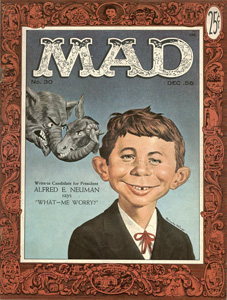
 That’s not a typo. It was a Mad magazine cover – Mad having been the Onion or Babylon Bee of its day – and according to dpgreatlife, “Thimk” was a poke at Thomas J. Watson, Sr., who was once at NCR and later IBM. Watson’s simple mantra was “Think.”

The Atlantic recently ran a piece entitled THE RISE OF TECHNO-AUTHORITARIANISM Silicon Valley has its own ascendant political ideology. It’s past time we call it what it is.

In the relatively early days of Web 2, we wrote an editorial warning that the age of social was creating companies with greater populations than have most countries on the planet. In fact, we called them as nation-states, and warned back then that they could  become more powerful than any government on the planet. It might have taken them 10+ years, but it seems at least the Atlantic seems to be catching on. Read More...