Browsed by
Category: Advice

The Video Revolution in the Age of Remote

The Video Revolution in the Age of Remote

While we are well aware of the fact that people have been untethering from television for quite some time, viewership has also been plummeting when it comes to the various mainstream news services. The numbers are in a free fall.

While the term ‘fake news’ has been bandied about ad nauseam and has become so much part of the patois that social media also affixes ‘potential fake news’ labels on tweets and posts that are not in lockstep with the media talking points. But no matter what’s reported, note to self: who can’t grab a photo or video with their phone these days? What the media reports, thanks in no small part to editing and green screen, and what onlookers post can sometimes seem like alternate realities and given this, even the major news outlets no longer have a monopoly over the message.

Publications are no longer necessarily authentic in their reporting, either. Prior to the last election, we’d do our usual perusal of tech articles, and noticed that the reporters always added a political aside which would have nothing to do with the story itself or the technology that was being featured. We began unsubscribing: How could we trust a reporter who was writing about, say, a dating app, then slipped in, say, a climate change aside, which had nothing at all to do with said app? The trust was gone.  So long, and thanks for all the fish. Read More...
The Great Tech Disconnects

The Great Tech Disconnects

Jennifer, Mara, Astrid & Aniyia on Medium

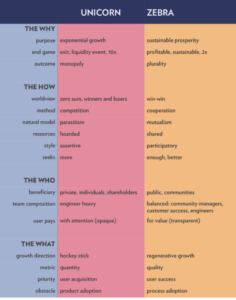
How many times have we heard that the VC model is broken? Of course everyone is looking for a unicorn and the big pay-off, but considering the rate of failure of startups, are investors missing the forest though the trees?

That’s not the only disconnect. Again, pay attention.

We found an interesting piece from a few years back (2017) about investing in zebras (Zebras Fix What Unicorns Break), as opposed to unicorns which, let’s face it, are mythical creatures after all, while are zebras slow but steady growth companies that tend to solve real world problems, as opposed to a unicorn such as, for example, Google, which has created more problems for the world than it has solved. That sort of software isn’t eating the world, as Marc Andreessen once said: it’s more or less attempting to chew it up and spit it out. Read More...

The Shift in the Attention Economy

The Shift in the Attention Economy

Image by John Hain

We’ve long been under glaring misconception that the tech uberlords are the smartest guys in the room. Is it that, or were they simply the first guys in the room? Pay attention:

Big Tech has been flexing its muscles more and more, censoring, deplatforming and demonetizing its users, not exclusively for political or ‘inappropriate’ content, or simply coming up with ‘creative’ ways to bring in more for me, but not for thee – because they can.

We know that, certainly since the Age of Social, the platform formerly known as the information superhighway has become a one-way street, but things are shifting and note to self: the cabal is starting to feel the repercussions. Read More...

The Earthquake in Chile: A Parable for a Green World

The Earthquake in Chile: A Parable for a Green World

The reference is to a novel by Heinrich von Kleist, where nothing happens the way one would expect, and all things are not what they seem.

Jenny Fielding, Managing Director of Techstars New York City Accelerator, which recently selected its latest batch of cohorts, penned a piece (New World, New Focus. How Application Trends at Techstars NYC Point to a Changing World) about the shift in focus of the entrepreneurs, given the current climate. And always important for founders to look to what the problems are, find the white space, and take it from there.

Speaking of climate, much attention has been given in the past few years to climate change. As always, important to look around, see what the problems are and find the white space. Glaringly obvious this past week were the events in Texas, when a devastating cold snap caused the windmills to freeze and the power grid to fail. Read More...

Build Back Different

Build Back Different

We’ve mentioned Clubhouse before and attention must be paid: it proved to be a game-changer – big time – the likes of which we haven’t seen in a while. Clubhouse has taken social media into a different direction. While Twitter and even Facebook have been something of town squares, CH is not that: it’s the corner pub or sort of unconference  or coffee klatch, where people can wander in and out of ‘rooms,’ at will, and participate, or simply listen and learn.

Although, CH members, take note: Clubhouse Users’ Raw Audio May Be Exposed to Chinese Partner.

So, what’s next? Well, the Twitter and Facebook knock offs, of course. Considering that both platforms are losing users and revenue (Twitter reports $1.14B net loss for 2020 – and that was before CH hit the zeitgeist in a significant way, and Facebook has been hemorrhaging users in its most valuable markets for some time now, what to speak of the face that Apple Privacy Change May Cost Facebook, Google $25 Billion Over Next 12 Months), they still believe that they will forever hold sway as the Masters of the Universe, so why innovate when you can appropriate? Read More...

Will the Real Silicon Valley Please Stand Up…

Will the Real Silicon Valley Please Stand Up…

And thank you, Slim Shady

There’s no doubt that the technology sector has become less tethered to the big cities and major tech hubs – Silicon Valley, New York City and Boston spring to mind – as a result of now long-standing Draconian lockdowns. The exodus from the Bay Area in particular has been well documented. According to The New York Times, They Can’t Leave the Bay Area Fast Enough. After all, The Times noted, “Rent was astronomical. Taxes were high. Your neighbors didn’t like you. If you lived in San Francisco, you might have commuted an hour south to your job at Apple or Google or Facebook. Or if your office was in the city, maybe it was in a neighborhood with too much street crime, open drug use and $5 coffees…But it was worth it. Living in the epicenter of a boom that was changing the world was what mattered. The city gave its workers a choice of interesting jobs and a chance at the brass ring.”

That was then. This is now and precisely to where has the sector gravitated?  “They fled to states without income taxes like Texas and Florida,” said The Times. Read More...

Meet the New Club. Not the Same as the Old Club

Meet the New Club. Not the Same as the Old Club


It isn’t often that a newco launches that fairly quickly captures unicorn-level attention the way that Clubhouse has. The audio-only social network, which has amassed 2M+ users and $100M in funding in just under a year after launch, seems to have raised the bar by lowering the barrier to participation, meaning, that in most rooms, anyone can raise their hand and, in most cases (depending on the moderator), participate in the discussion. It’s still in beta, so it’s currently iPhone only and invitation only: patience.

“If you could plug into a live conversation about a topic, you’re passionate about, on demand, anywhere in the world, and have an opportunity to not only listen to some of the smartest people on the subject, but also participate with them, would you?” asked Brian Solis in Forbes (The Latest Silicon Valley Unicorn, Clubhouse Raises $100 Million And Also Raises Attention To The Importance Of Audio-Based Social Networking). “…it represents an unquenchable thirst for meaningful community and engagement, especially in light of the chaos and devastation that played out in the forms of disinformation, political theater, and divisiveness across other social networks.” Read More...

Is There Nothing Bill Gates Can’t Do???

Is There Nothing Bill Gates Can’t Do???

There’s no doubt that Bill Gates is considered something of a hero. With his wealth, power and influence, he has never shrunk from addressing some of the world’s most pressing problems. And he certainly has the wealth, power, influence – and hubris – to do just that.

The Microsoft Days

Back in the olden days of tech, there was a company called Microsoft, which is still around, but in the olden days, the CEO was the company’s founder – a Harvard drop out named Bill Gates, who stole his operating system from Xerox Parc (as did Steve Jobs). Back in the Bill Gates days of MSFT (before he turned the CEO spot over to Steve Ballmer no doubt due in no small part to the government’s antitrust case against the company), MSFT was known for basically three overarching things: products that didn’t work/were buggy/caused the air-sucking blue screen of death, as they were often released before their time; their predatory habits (in those days MSFT was referred to as the Evil Empire); and their desire to crush all competitors. Their charge was basically to win at all costs and if you believe that Gates has changed, here’s a must read: Bill Gates’s Philanthropic Giving Is a Racket.

Here are some of the verticals on which Gates is focused:

Education: Notes The Federalist (Bill Gates Tacitly Admits His Common Core Experiment Was A Failure), “Since 2009, the Gates Foundation’s primary U.S. activity has focused on establishing and implementing Common Core, a set of centrally mandated curriculum rules and tests for what children are to learn in each K-12 grade, with the results linked to school and teacher ratings and punitive measures for low performers. The Gates Foundation has spent more than $400 million itself and influenced $4 trillion in U.S. taxpayer funds towards this goal. Eight years later, however, Bill Gates is admitting failure on that project, and a “pivot” to another that is not likely to go any better.” Despite the fact that, according to The New York Times (The Common Core Costs Billions and Hurts Students), “It was a rush job, and the final product ignored the needs of children with disabilities, English-language learners and those in the early grades… There is nothing to show for it… Last year, (2015) average math scores on the National Assessment of Educational Progress declined for the first time since 1990; reading scores were flat or decreased compared with a decade earlier.” Read More...

Investors in the Hot Seat

Investors in the Hot Seat

Image by mohamed Hassan from Pixabay

We work with and/or coach entrepreneurs all the time, and recently realized that many founders have no idea how the VC model works, meaning how and why VCs deploy funds – and make decisions – the way they do. So we’re going to shift the perspective to help you to better understand the process.

You go to investors because you need capital in order to get your company to the next level. Time to think about VC firms as companies as well, because they are. Some of them are large companies, re have a bigger war chest of funds to deploy, but truth be told, the majority are more akin to SMBs. Where does the money come from for the funds? Family offices, high net worth individuals, strategics (eg companies/corporations aligned with the investment vertical or thesis of the fund) or institutional investors (pension funds, university endowment funds, sovereign wealth funds, etc), and the funds manage their investments. The fund’s investors invest in specific funds for various reasons: the expertise of the team, the fund’s track record, their spidey sense, alignment of focus, etc.

Like the VCs who invest in your company, those LPs expect a return on their investments. If the fund fails to do that, well, they’re going to have a harder time attracting investors themselves when they go to raise their next fund, or to put it into startup terms, their Series A, B, whatever. Read More...