Browsed by
Author: Bonnie

Basecamp: Corporate Responsibility’s New Normal?

Basecamp: Corporate Responsibility’s New Normal?

Basecamp touched off a firestorm on social media and in the tech press recently when co-founder Jason Fried announced six “directional changes” to company policies, including “No more societal and political discussions on our company Basecamp account…People can take the conversations with willing co-workers to Signal, Whatsapp, or even a personal Basecamp account, but it can’t happen where the work happens anymore.”

According to The Verge, it all began due to a list of names. “Around 2009, Basecamp customer service representatives began keeping a list of names that they found funny… Many of the names were of American or European origin. But others were Asian, or African, and eventually the list — titled “Best Names Ever” — began to make people uncomfortable. What once had felt like an innocent way to blow off steam, amid the ongoing cultural reckoning over speech and corporate responsibility, increasingly looked inappropriate, and often racist.”

When Fried interceded with his announcement, the Twitterverse exploded, as did the online press (“Basecamp sees mass employee exodus after CEO bans political discussions,”said Tech Crunch), although Fried did not ban political discussions: he merely banned them at work. Read More...

The Return to the Office and Other Remote Possibilities

The Return to the Office and Other Remote Possibilities

If there’s anything that the last year or so has shown us it’s that, for better or for worse, humans are very adaptable creatures. For example, in the early days of Covid, Google was one of the first companies to have their employees work remotely. There was a culture shock: forcing employees, who were accustomed to spending the majority of their waking hours at the office, to work solely from home.

Now the company is doing an about face. Read More...

Audio-Only Platforms: Listen and Learn

Audio-Only Platforms: Listen and Learn

The lockdowns have certainly had a huge impact on the online world. First, Zoom mushroomed from out of nowhere, and when Zoom fatigue seemed to be setting in, there was Clubhouse, taking over the zeitgeist and becoming, as the Daily Caller noted (in Here’s What We Know About Clubhouse, The New App That’s Dominating Social Media), the fifth most popular social media app on the Apple store, trailing behind only Facebook, Messenger, Discord, and WhatsApp.


Not to be outdone, Facebook is launching several new audio-only features, including “Soundbites…and an audio-only version of Rooms (called Audio Rooms – think Clubhouse).” as The Sun reports. Read More...

Eco-Friendly? Sustainable? Things that Make You Go ‘Hmmm.’

Eco-Friendly? Sustainable? Things that Make You Go ‘Hmmm.’

And thank you, C+C Music Factory.

‘Sustainable,’ ‘circular economy,’ and ‘environmentally conscious’ are definitely practically de rigueur among entrepreneurs these days and we are totally on the same page. In fact, we’ve been composting for years. But are products et al that people call sustainable, truly sustainable – or eco friendly. There are just a few points/examples of things that make you go hmmm that we’d like to share as a sort of nudge to you, and/or to provoke something of a head-scratching moment. Pay attention: science can sometimes be something of a shifting target:

  Read More...

Think Small

Think Small

Companies are easy to start, right? People do it all the time. Seeing it through to it becoming a thriving business and/or having a successful exit, well, that’s quite a different story. Stated another way, we had a professor in a fiction writing class in college who started the semester with: “I met a fellow at a party and asked, ‘So, what do you do?’ To which he replied, ‘I write the beginnings of novels.’”

Which, for the record, doesn’t make you a novelist. You’ve got to see it through to that last page. And publish!

Igor Jablokov, who is a founder rather than investor, spoke at one of our investor breakfasts a while back, and it’s amazing what you can learn from someone who has been there, done that – and who has had a successful exit. Igor had a company, and as he was building, he would go to various conferences and expos to network, and to see what he might learn. At one conference, he spoke to a group who had had a very successful exit and he asked how it had happened. Read More...

1984: Blueprint for the New Normal

1984: Blueprint for the New Normal

George Orwell. Photo from Gordon Johnson/Pixabay

This just in: Wall Street A-Listers Fled to Florida. Many Now Eye a Return, Bloomberg News reported. For the record, “USPS data shows few New Yorkers moved to Miami, Palm Beach; New Jersey, California and Connecticut were most popular moves.”

Looks like things are about to return to normal, right?

In case you missed it, Google will invest $250 million this year in building out New York City office presence, while Facebook Bets Big on Future of N.Y.C., and Offices, With New Lease, and note to self, “With the 730,000-square-foot lease, Facebook has acquired more than 2.2 million square feet of office space in the city for thousands of employees in less than a year, all of it on Manhattan’s West Side,” the New York Times reported. Meanwhile, we saw Amazon buying Lord & Taylor building for $1.15 billion, “While Facebook has been in talks to lease the 700,000-square-foot Farley Building, Apple last month inked a lease on 220,000 square feet at 11 Penn Plaza,” said the New York Post. Why Is Jeff Bezos Buying Up Apartments in the Coronavirus Capital?, Realtor.com queried during the height of the pandemic.

Why indeed and lest we forget, all of these companies already had a considerable footprint in NYC even prior to the pandemic. While many formerly NY-based companies, shops and restaurants pulled up stakes – or were driven out due to high rents and property damage – seems that the various members of the tech cabal didn’t bat an eyelash, and rather, waited for real estate prices to drop, even though it seems some will still pay top dollar. Read More...

The Video Revolution in the Age of Remote

The Video Revolution in the Age of Remote

While we are well aware of the fact that people have been untethering from television for quite some time, viewership has also been plummeting when it comes to the various mainstream news services. The numbers are in a free fall.

While the term ‘fake news’ has been bandied about ad nauseam and has become so much part of the patois that social media also affixes ‘potential fake news’ labels on tweets and posts that are not in lockstep with the media talking points. But no matter what’s reported, note to self: who can’t grab a photo or video with their phone these days? What the media reports, thanks in no small part to editing and green screen, and what onlookers post can sometimes seem like alternate realities and given this, even the major news outlets no longer have a monopoly over the message.

Publications are no longer necessarily authentic in their reporting, either. Prior to the last election, we’d do our usual perusal of tech articles, and noticed that the reporters always added a political aside which would have nothing to do with the story itself or the technology that was being featured. We began unsubscribing: How could we trust a reporter who was writing about, say, a dating app, then slipped in, say, a climate change aside, which had nothing at all to do with said app? The trust was gone.  So long, and thanks for all the fish. Read More...

The Great Tech Disconnects

The Great Tech Disconnects

Jennifer, Mara, Astrid & Aniyia on Medium

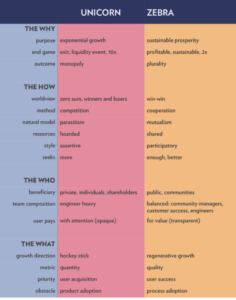
How many times have we heard that the VC model is broken? Of course everyone is looking for a unicorn and the big pay-off, but considering the rate of failure of startups, are investors missing the forest though the trees?

That’s not the only disconnect. Again, pay attention.

We found an interesting piece from a few years back (2017) about investing in zebras (Zebras Fix What Unicorns Break), as opposed to unicorns which, let’s face it, are mythical creatures after all, while are zebras slow but steady growth companies that tend to solve real world problems, as opposed to a unicorn such as, for example, Google, which has created more problems for the world than it has solved. That sort of software isn’t eating the world, as Marc Andreessen once said: it’s more or less attempting to chew it up and spit it out. Read More...

The Shift in the Attention Economy

The Shift in the Attention Economy

Image by John Hain

We’ve long been under glaring misconception that the tech uberlords are the smartest guys in the room. Is it that, or were they simply the first guys in the room? Pay attention:

Big Tech has been flexing its muscles more and more, censoring, deplatforming and demonetizing its users, not exclusively for political or ‘inappropriate’ content, or simply coming up with ‘creative’ ways to bring in more for me, but not for thee – because they can.

We know that, certainly since the Age of Social, the platform formerly known as the information superhighway has become a one-way street, but things are shifting and note to self: the cabal is starting to feel the repercussions. Read More...