Not the usual editorial today due to the holidays and hope that you managed to enjoy! We’d like to take this opportunity to reflect on the meaning of each.
Passover is the celebration of a people’s escape from bondage, led by Moses. Do we really need to draw parallels to the overarching intrusions and controls presently in our lives that both governments and tech are now enacting, globally?Read More...
Post 9/11, Americans feared for their collective safety. Two hijacked planes brought down the World Trade Center. Another hit the Pentagon. The fourth was diverted by a handful of passengers who downed it in a field in Pennsylvania rather than risking it hitting its intended target. The result: the Patriot Act (which was quietly renewed while we were being distracted by the ‘impeachment’), an acronym for “Providing Appropriate Tools Required to Intercept and Obstruct Terrorism.” Under the guise of making Americans ‘safer,’ it also infringed on the rights of citizens by giving law enforcement officials permission to collect intelligence on citizens, reducing public accountability; reducing the ability of the public to go to court to challenge a government search; allowing government officials to target citizens not under criminal investigation, and allowing unlawful imprisonment by denying due process.
Now there’s Covid-19 and even more of our freedoms have been eroded in just a few short months. Without a shot being fired, 40% of the world is basically under house arrest/lockdown under the guise of sheltering in place. Tomatoes, tomahtoes.Read More...
How many times have we heard lately that the world will never be the same again? Time will tell, and important to see how habits have changed in the relatively short amount of time that has elapsed since the onset of the Wuhan virus panic.
People are working, eating – and cooking – more at home. Many restaurants have shuttered – some, at least, only temporarily – and we suppose that there’s just so much McDonald’s and pizza one can consume on a daily basis. Don’t have mad skills in the kitchen? As we mentioned last week, Blue Apron’s stock suddenly soared. We’ve also noticed more FreshDirect trucks on the street, and no surprise that Instacart is hiring 300,000 grocery shoppers (although, workers protest at Instacart, Amazon and Whole Foods for health protections and hazard pay, reports the Washington Post). People are presumably cooking and note to self: there will always be businesses that do well, as conditions and circumstances change and also note, re the WaPost piece: “Grocery store, delivery and warehouse workers have unprecedented leverage to demand better working conditions during the coronavirus pandemic because their labor has become essential for millions of Americans.”Read More...
In a world turned upside down and gripped with panic, we thought we’d point out a few pieces of information that you might have missed, and a few potential opportunities that you may be missing:
The headline is a reference to a 1985 novel written by Nobel prize winning author Gabriel García Márquez. Namely, Love in the Time of the Cholera.
China did not immediately inform the world that the Corona virus was out there.
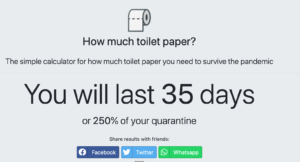
We know that the current virus is not the flu, but the two do share certain symptoms, and we will remind you that not every case is a death sentence. Chances are, it started spreading before the city of Wuhan was quarantined, especially given the fact that the US has already seen 21,000 deaths from the ‘flu’ this season – much higher than normal – and million upon millions of instances where people recovered, despite the fact that they were bereft of the magical properties seemingly imbued by hording large amounts of toilet paper.Read More...
How to Pitch to Investors (Trust Us, You’ve Got It All Wrong)
We attended Peak Pitch last week, and thought we’d share some of the lessons that we gleaned from the experience. Namely, points about pitching to investors that every entrepreneur needs to know.
FYI, every year, Peak Pitch brings together 40 or 50 seed and series A investors (some of whom may come from finance, while others are recovering entrepreneurs themselves) and 40 to 60 curated founders for networking and informal pitches on the slopes. Skiing is not mandatory. Pitches can also be done fireside, speaking of warm introductions. There is no shortage of investors there to listen, give constructive criticism or offer advice. The activities and shared experiences are enjoyable, to be sure, but at the end of the day (actually, all day long), everyone is there to do business.
We reviewed What Investors Are Really Looking For in a pitch deck just last week. Since Peak Pitch is the next stage – your deck has passed muster and you’ve moved up to the next level – what’s the drill once you have the ear of an investor – or 40? It’s not just a rehash of your deck. It’s the points that are going to pique and keep an investor’s interest.Read More...
The Pitch Deck: What Investors Are Really Looking For
It’s been a while since we discussed pitch decks, and it seems that it may be time for a refresher course/reminder.
We all know that there are a few points to cover. Again, in no particular order:
Vision and Value
Problem
Market/Opportunity
Solution
Business/Revenue Model
Competiton
Traction/Road Map to Traction (aka Go To Market Strategy)
Marketing and Sales Strategy
Team
Financial
Ask/Use of Funds
If this is the latest project from a team of very successful serial entrepreneurs, you’re going to move that ‘team’ slide up. Investors want to know that if this startup’s founders are, say, Larry Page and Sergey Brin.Read More...
Dudes, just dudin’ it up: Softbank and the Bro Culture
The Softbank Vision Fund hasn’t had an easy time of it and we use this as an example of the bro-cul (bro-culture) focus that might have contributed to some of their current woes.
They’re not alone. Simply more heavily tracked by the tech media.
First, there was WeWork, which very publicly and unceremoniously came crashing down (time will tell if new CEO Sandeep Mathrani, who comes from the real estate sector and has a successful turnaround history, according to the Bloomberg News, will save the company), despite CEO Masayoshi Son’s abundant/blind faith in ousted founder/tech-bro Adam Neumann (we are aware that WeWork is not nor was it ever a tech company, but Neumann did manage to spin it that way).Read More...
Does There Have to Be an App for That? The Votes Aren’t All In Yet
Despite the fact that it is ubiquitous, software is never easy to build and/or scale. In case you’ve been hiding under a rock, or from the various virulent viruses and flus that are going around, the Democratic Iowa caucus decided to go the tech route to capture and tabulate their voting results last week, and why not? We all have apps on our phones. Which we use seemingly constantly, if the numbers are any indication (Americans check their cell phones 150 times a day) and since we’re all so cell phone-enabled, why not a voting app? The tech community has been advocating for this for quite some time. Although, given the number of hacks we’ve seen and/or experienced and the tech community’s seeming unwilling to address security flaws (Google discovered several iPhone security flaws, and Apple still hasn’t patched one), what could possibly go wrong?
Enter the Iowa caucus debacle, where everything that could go wrong, did go wrong.
But this isn’t about what went wrong: since this is an election year, rife with contentious candidates and no shortage of social media platforms, this is a heads up to entrepreneurs who wish to step into the fray with their own tech offerings and we know that you’re out there.Read More...