Browsed by
Tag: #MarkZuckerberg

As the FAANG Founders Turn – On Each Other

As the FAANG Founders Turn – On Each Other

Image by Gerd Altmann from Pixabay

You have to give Mark Zuckerberg credit. Love him or hate him, he does act very deliberately, even if you might believe that it is with malice aforethought.

Netflix founder and CEO Reid Hastings resigned from the Facebook board this past week. Peggy Alford, currently senior vice president of Core Markets for PayPal, will be nominated to join the board of directors and become its first black member, but there’s a clear case of missing the forest through the trees here.

Facebook is reportedly spending $1 billion on producing original content. When Hastings joined the board in 2011, he said that he had been trying to figure out how to integrate Facebook and make Netflix more social, so getting on the board was a good deal, according to Business Insider. Read More...

Is Tech Taking Us Backwards?

Is Tech Taking Us Backwards?

The focus du jour seems to be regulation of the internet, and the fact that now even Mark Zuckerberg wants new legislation to limit speech. How interesting that in twenty-odd years, we’ve gone from the internet being a vehicle where information wants to be free, to censorship.

If this is what you’re focused on, you’re missing something. Namely, the fact that the current push is not only for censorship of speech, but concurrently, for no speech at all. Read More...

Beware Big Companies ASKING to be Regulated

Beware Big Companies ASKING to be Regulated

In a seeming change of heart, Mark Zuckerberg backs stronger Internet privacy and election laws: ‘We need a more active role for governments’, he said, and no, there wasn’t a sudden rip in the universe. Zuckerberg penned an opinion piece in the Washington Post entitled The internet needs new rules. Let’s start in these four areas, which are harmful content, election integrity, privacy and data portability.

The editorial, no doubt, comes on the heels of the attention that Facebook, Twitter, Google and Amazon have been getting from Congress and various Presidential candidates, and as a result of the recent announcement that Facebook, Twitter and YouTube execs face jail and multi-billion pound fines over terror videos. “Australia could become the first country to introduce prison terms and fines if firms fail to speedily remove terror videos like the Christchurch massacre live-stream,” reports The Sun. Read More...

Social versus Real Life: Where’s the Balance?

Social versus Real Life: Where’s the Balance?

The reports are in. People are leaving Facebook, and/or spending less time on the platform. It seems that for all of Mark Zuckerberg’s claims that Facebook’s intention is to bring the world closer together, people may well be finding each other online, but it seems that they aren’t necessarily liking what they find.

Or that the online experience simply isn’t enough. Read More...

Watch Where the Puck Is Going, Not Where It Has Been

Watch Where the Puck Is Going, Not Where It Has Been

The World Wide Web turned 30 this past week. Web creator Tim Berners-Lee marked the occasion by noting that the web is now dysfunctional with ‘perverse’ incentives, while Facebook founder and CEO Mark Zuckerberg seems to have marked it by announcing Facebook’s new pivot to privacy. Trust us, he did not suddenly have a come to Jesus moment. The only pivot here in his manifesto is away from Facebook’s current town square format into one focused more on the ability to have private messages among people and groups, which is the way that Facebook users had been going anyway.

“I believe the future of communication will increasingly shift to private, encrypted services where people can be confident what they say to each other stays secure and their messages and content won’t stick around forever. This is the future I hope we will help bring about,” said Zuckerberg in his manifesto. Read More...

The Fine Line Between Culture and Cult

The Fine Line Between Culture and Cult

Erin Griffin recently wrote an excellent piece in The New York Times entitled Why Are Young People Pretending to Love Work? “Never once at the start of my workweek…have I paused, looked to the heavens and whispered: #ThankGodIt’sMonday,” writes Griffin. Yet that is the culture that’s being bred, most explicitly at WeWork (now the We Company), where “Neon signs demand they “Hustle harder,” and murals spread the gospel of T.G.I.M. Even the cucumbers in WeWork’s water coolers have an agenda. “Don’t stop when you’re tired…

“It’s not difficult to view hustle culture as a swindle. After all, convincing a generation of workers to beaver away is convenient for those at the top.” Read More...

Surveillance Capitalism: We Are Definitely the Product

Surveillance Capitalism: We Are Definitely the Product

The tech cartel has been labeled many things. “Attention Merchants” being one of them. In her new book, The Age of Surveillance Capitalism: The Fight for a Human Future at the New Frontier of Power, Shoshana Zuboff has designated a new category for them: Surveillance Capitalists. “Surveillance capitalism,” she writes, “unilaterally claims human experience as free raw material for translation into behavioural data.

The Business of the Internet

“When the security expert Bruce Schneier wrote that “surveillance is the business model of the internet,” The Guardian reports, “he was really only hinting at the reality that Zuboff has now illuminated. The combination of state surveillance and its capitalist counterpart means that digital technology is separating the citizens in all societies into two groups: the watchers (invisible, unknown and unaccountable) and the watched. This has profound consequences for democracy because asymmetry of knowledge translates into asymmetries of power. But whereas most democratic societies have at least some degree of oversight of state surveillance, we currently have almost no regulatory oversight of its privatised counterpart. This is intolerable.” Read More...

140 Characters Who Helped Shape the Tech World

140 Characters Who Helped Shape the Tech World

It was Peter Thiel who said, “We were promised flying cars. Instead we got 140 characters.” It looks like flying cars may be slowly rolling out, with Singapore’s flying taxi trial set to begin in the second half of 2019, but who the hell are those 140 characters to whom Theil might have been referring? As a co-founder of PayPal and an early investor in Facebook, LinkedIn, Yelp and Quora, he certainly knows what sorts of characters tech can breed.

We’ve been involved in the tech world since the nascent days of Web 1.0 in New York City – with monthly trips to Silicon Valley at the time, as well – and over the years, have encountered many of those characters, upfront and personal, for better or for worse. Of course we have stories to tell, but that’s for a later date and a much longer opus.

Some were true innovators who created platforms and software and devices that forged an entirely new industry. You may not be familiar with their names, but their contributions should never be forgotten. Some forgot their original drivers, whether it was to not be evil or to connect the world, tracked the world’s population in ways and to an extent to which it had never been tracked before, storing it and parsing out that information to the highest and/or any and all bidders, and paying no heed to the concept that we might have the right to be forgotten. Read More...

Big Tech is riding the same rails as robber barons of the past

Big Tech is riding the same rails as robber barons of the past

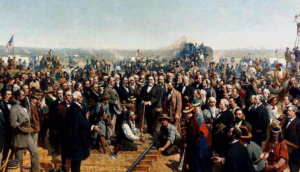
The Last Spike, 1869.

The tech industry – in particular, the FAANG stocks – have hit a strange inflection point. They’re taking a beating on Wall Street. And Facebook is under attack from all sides.

There was The New York Times piece (Delay, Deny and Deflect: How Facebook’s Leaders Fought Through Crisis), which was written with the assistance of no less than 50 sources.

An international committee of foreign governments has requested that Zuckerberg appear before lawmakers to face inquiries, particularly into disinformation, election meddling and privacy issues. Zuckerberg refused. Read More...

Is This the Social Media Tipping Point?

Is This the Social Media Tipping Point?

Mark Zuckerberg Quietly (Sold) His Facebook Stock back in March and as Recode reported in February, Mark Zuckerberg will likely sell billions of dollars of Facebook stock this year. He’s not alone. On Friday, Satya Nadella unload(ed) 30% of his Microsoft common stock in his biggest sale as CEO.

The Age of Social has reached a tipping point, and it’s taking all of tech with it.

Some can see the writing on the wall and are cutting their losses. Read More...